
Southern Marsh Orchids

Thursday, 16 January 2014
Rust
As a follow up to my post about Morlais quarries, I have now identified the rust fungus that was so abundant on the leaves of Salad Burnet (Sanguisorba minor). It is Phragmidium sanguisorbae, but as to its status, this NBN dot map gives an idea, but as with all these under recorded organisms I doubt if it gives a particularly accurate idea of its true status. As always with these things, I suppose it is common where the host plant grows.

Tuesday, 14 January 2014
Glamorgan Botany Group excursions
A report on the Glam Bot Group's five excursions made during 2013 is available on the BSBI website at the following link:
http://bsbi.org.uk/Glamorgan_excursions_2013.pdf
To my shame I failed to attend any of the meetings this year, though I fully intend to rectify this in 2014.
George
http://bsbi.org.uk/Glamorgan_excursions_2013.pdf
To my shame I failed to attend any of the meetings this year, though I fully intend to rectify this in 2014.
George
Thursday, 9 January 2014
Distinctive Lichen

Glamorgan, I like to keep an eye on it. It is quite a large, leafy lichen; bright green, with pale undersides to the thallus and those tell-tale blackish, raised cephalodia. P. leucophlebia is only to be found in calcareous situations and there is a very similar Peltigera: P. britannica, which is only found in acid situations in uplands. The cephalodia of P. britannica can be easily scratched off, leaving a pale scar, but those of P. leucophlebia cannot be easily removed.
Although the quarries are quite extensive, this lichen only grows in parts of the upper tiers of the middle and upper branches of the quarries, usually amongst slightly taller vegetation on the areas that are less grazed by sheep. I was encouraged to find it to be even more abundant on some areas I haven't checked before.
While there I also came across this local crustose lichen: Gyalecta jenensis, which has distinctive orange centred apothecia. It is often found in growing along cracks and fissures in the vertical faces of the limestone and commonly colonises mosses already growing there.
 |
| Gyalecta jenensis, probably on what was formerly a small clump of
moss.
|
 |
| Caught in the act of colonising a moss |
This rust fungus was quite abundant on the Salad Burnett up there. When I get the chance, I'll drag the microscope out and identify it.


Monday, 6 January 2014
Another spider
I picked up another spider a few days ago. This one was living amongst the strandline debris on the beach immediately in front of Aberthaw power station. An unusual habitat for a spider!
It turned out to be the Linyphiid or Money spider Halorates reprobus. It is an interesting species in that Britain is the centre of the population; apparently there are relatively few records from continental Europe. In Britain it is widespread around the coast but thinly distributed. The Spider Recording Scheme data suggests few previous records of this species from Glamorgan:

Link : http://srs.britishspiders.org.uk/portal.php/p/Distribution/s/Halorates+reprobus/o/23/u//x/
Source: Source: Spider Recording Scheme/British Arachnological Society (2012) Website and on-line database facility
It is a relatively small spider at approx 3mm long. Too small in fact for my camera to get a reasonable pic of it. If anyone wants to have a look there are some pics here.
It will be interesting to see if the population at Aberthaw is still there in a few months time after the storms have finished lashing the coast!
It turned out to be the Linyphiid or Money spider Halorates reprobus. It is an interesting species in that Britain is the centre of the population; apparently there are relatively few records from continental Europe. In Britain it is widespread around the coast but thinly distributed. The Spider Recording Scheme data suggests few previous records of this species from Glamorgan:
Link : http://srs.britishspiders.org.uk/portal.php/p/Distribution/s/Halorates+reprobus/o/23/u//x/
Source: Source: Spider Recording Scheme/British Arachnological Society (2012) Website and on-line database facility
It is a relatively small spider at approx 3mm long. Too small in fact for my camera to get a reasonable pic of it. If anyone wants to have a look there are some pics here.
It will be interesting to see if the population at Aberthaw is still there in a few months time after the storms have finished lashing the coast!
Friday, 3 January 2014
Coconut Surprise
Having mentioned the coconut I found washed up at Kenfig two or three years ago, I hope you don't mind me posting some photos of it here. Before setting sail for these shores it seems to have spent some time on the ground, where it got bored into by creatures unknown and the husk may have started decaying.
I believe all the above features qualify this as a true ocean traveller.
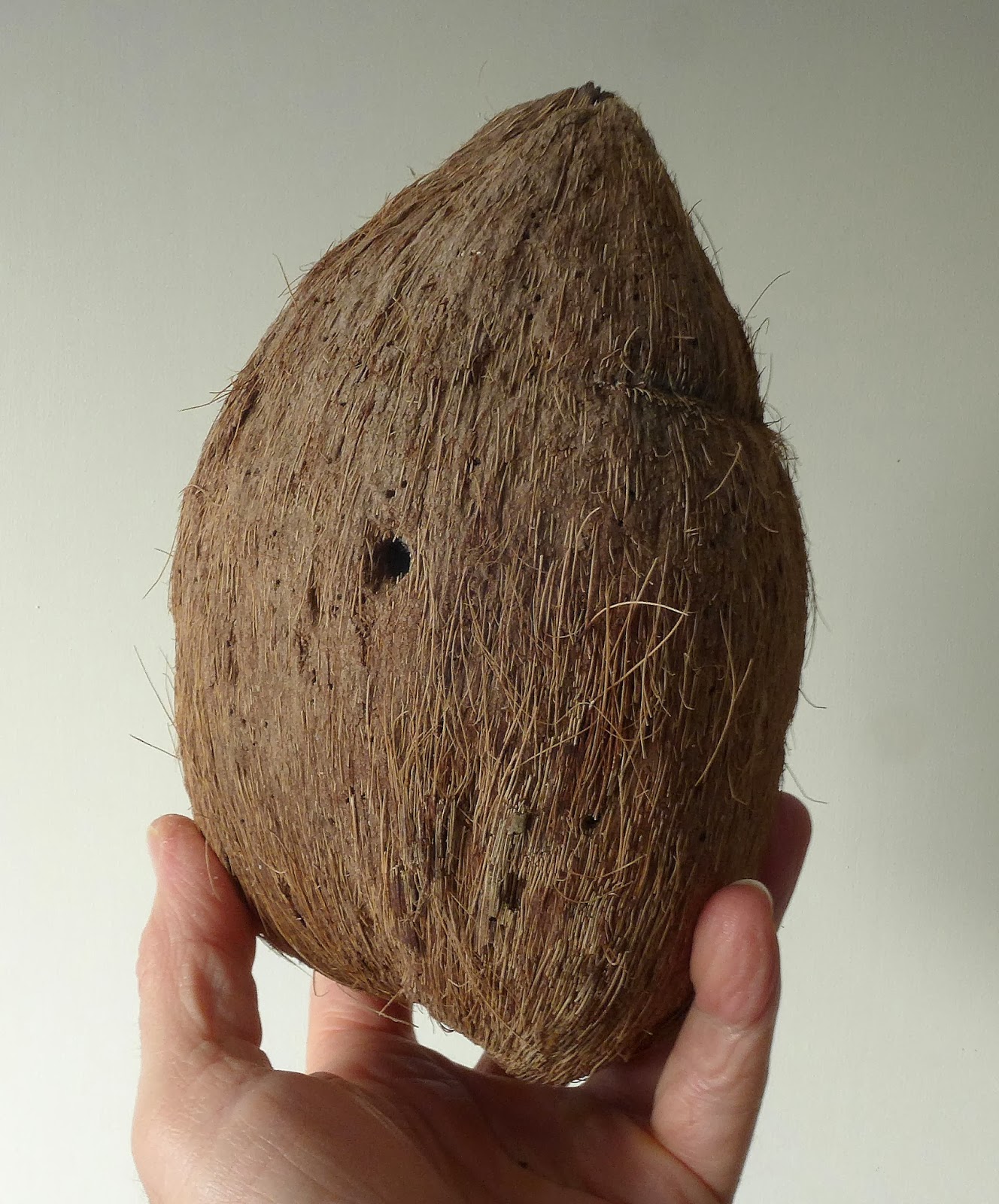 |
| Note the small holes. |
 |
| Viewed from the base, through a hole in the husk can be seen the nut, with a Serpulid worm tube. |
 |
| The nut seen through the three holes at the top of the husk. |
I believe all the above features qualify this as a true ocean traveller.
Thursday, 2 January 2014
Tegenaria agrestis
Whilst out on the obligatory Boxing Day stroll I spotted a spider from the Tegenaria family that was lurking under a stone in a nearby abandoned quarry. There are about 10 species of Tegenaria found in Britain, and they include the big scary hairy House Spiders that seem very fond of arachnophobes in the autumn when they move indoors to escape the inclement weather. They are quite distinctive looking as a groups, but like many spiders are impossible to separate on the basis of pattern or colour. It is necessary to look at the male palps or the female epigyne under a microscope.
This one was not one of the commoner species such as the familiar House Spider, but Tegenaria agrestis.

It was first recorded in Britain in 1949 and prefers disturbed brownfield habitats. It is a widespread European species and has a wide but patchy distribution across much of England but there are comparatively few records from Wales. Glamorgan records are restricted to a couple of sites to the West of VC41. It is thought to spread along railway lines, using the track-side ballast as an ideal habitat. Sure enough, the abandoned quarry south of Rhoose village is less than a hundred metres from the Aberdare to Bridgend line that services Aberthaw power station. It is quite likely to be present in other areas of suitable habitat along the railway corridor I guess.
Link: http://srs.britishspiders.org.uk/portal.php/p/Summary/s/Tegenaria+agrestis
Source: Spider Recording Scheme/British Arachnological Society (2012) Website and on-line database facility
This one was not one of the commoner species such as the familiar House Spider, but Tegenaria agrestis.

It was first recorded in Britain in 1949 and prefers disturbed brownfield habitats. It is a widespread European species and has a wide but patchy distribution across much of England but there are comparatively few records from Wales. Glamorgan records are restricted to a couple of sites to the West of VC41. It is thought to spread along railway lines, using the track-side ballast as an ideal habitat. Sure enough, the abandoned quarry south of Rhoose village is less than a hundred metres from the Aberdare to Bridgend line that services Aberthaw power station. It is quite likely to be present in other areas of suitable habitat along the railway corridor I guess.
 | |
| Tegenaria agrestis distribution |
Source: Spider Recording Scheme/British Arachnological Society (2012) Website and on-line database facility
Wednesday, 1 January 2014
Springtail

Robbed of that particular opportunity, I went for a general forage and while examining one of the old wooden railway fence posts I noticed these tiny Springtails.
 |
| Entomobrya multifasciata |
 |
| Dicyrtomina saundersi |
Using a simple online key to Dutch Springtails, http://www.janvanduinen.nl/sleutel/key.php I have tentatively identified them as Entomobrya multifasciata and the globular springtail Dicyrtomina saundersi, which was on a nearby bramble leaf. They were minute and extremely difficult to photograph, pushing the abilities of my macro set up a little beyond its limits. I find Springails fascinating and there aren't too many of them, so it is possible to identify most of them.
Subscribe to:
Posts (Atom)