Southern Marsh Orchids

Southern Marsh Orchids

Saturday, 6 September 2014

Garth Hill - bryophytes and other wildlife


There is very little in the way of natural rock exposure in the Cardiff area. One of the best examples is at the eastern end of Garth Hill, where there are some attractive sandstone outcrops.

Last weekend I took a brief stroll up the Garth to have a poke around these outcrops for bryophytes. Before I even got to the hill, I stepped on a patch of Common Crystalwort (Riccia sorocarpa) rosettes, which were abundant in the car parking lay-by.
Riccia sorocarpa (click to enlarge)

The outcrops themselves support a nice bryophyte flora including several species typical of dry acidic rocks and the thin soil surrounding them, such as Bristly Haircap (Polytrichum piliferum) and Juniper Haircap (P. juniperinum), Bristly Fringe-moss (Racomitrium heterostichum), Hair-pointed Grimmia (Grimmia trichophylla) and the rather distinctive liverwort Ciliated Fringewort (Ptilidium ciliare).

Polytrichum juniperinum

Ptilidium ciliare
There were also several Bloody-nosed Beetles feeding on Heath Bedstraw, and the much smaller Sermylassa halensis (recently reported by Mark Evans on this blog) on the same plant.

Bloody-nosed Beetle and Sermylassa halensis
Two peacock butterflies roosting (or hibernating?) under a small rock overhang was a nice surprise.
Roosting Peacocks (just visible behind cobwebs)

Sunday, 31 August 2014

salmon at Radyr Weir

Out walking in the sunshine this afternoon and happened across the salmon leaping at Radyr Weir. Truly one of nature's wondrous events! Stayed for approx half hour watching as the salmon tried to negotiate the weir. Of the twenty or so that we saw make the attempt very few succeeded to continue the journey up-river, and we watched one struggling to maintain position half way up the weir only to be drift back down to try again.

I managed to grab a few photographs but they are a bit blurred!.

 Howard


Thursday, 28 August 2014

Garden visitors

Not a lot in the moth trap on Tuesday night but a number of interesting visitors in the garden.

Lots of spiders around, but this one caught the eye. I suspect it is a Walnut Orb Weaver and the white markings made it look quite sinister in the torchlight. it scurried away into the fencing when the flashlight hit it!


This ichneumon wasp was wandering around at the back of the garage and when photographing that I noticed the mating flies on the window frame. These don't look like the regular houseflies but show some similarities.


Tuesday, 26 August 2014

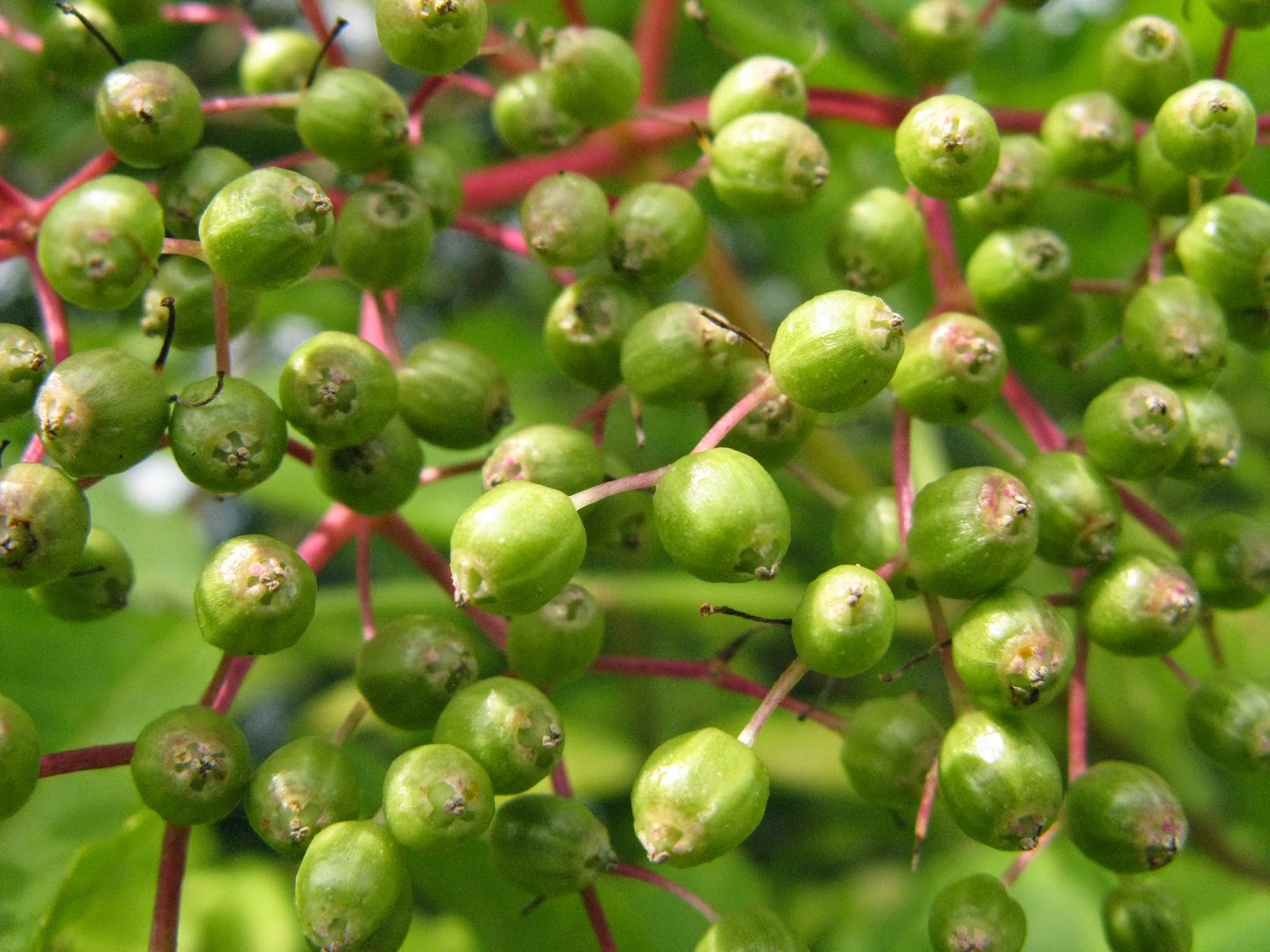
A green-fruited Elder at Llantrisant


I actually spotted this last year, but thought it was worth a quick post now for its curiosity value!

All fruits of Elder (Sambucus nigra) of course start off green, but the ones on this bush at Llantrisant stay that way as they ripen, before shrivelling and/or going mouldy.
 
Fruits of the green-fruited Elder...
 
...and for comparison unripe fruits of the ordinary black-fruited Elder.
 
It seems to be uncommon (it's the first time I've come across it in 15 years of botanising), but must be easy to overlook – Stace (edition 3) says the fruits of Elder are “sometimes" greenish-yellow.

This taxon was previously referred to as a variety (going under various epithets including viridis, chlorocarpa, virescens and leucocarpa), but is now demoted to a mere form (viridis). As well as the colour of the ripe fruits, I think their translucent look helps to distinguish them from unripe fruits of normal elderberries. In the photo you can also see that the fruit-stalks aren't as strongly red-coloured.
 
And the taste test? They’re not bad, actually!

Cardiff coastal path

Two of the 28 spikes of Autumn Lady's Tresses found today along the Cardiff coastal path near the Water Treatment Works. This is the first time I've found them on the eastern side of the heliport. This is the only area where this species is known from in the Cardiff UA [per database].
Photo from iPhone. 

Sunday, 24 August 2014

A Tiny Gem

Wandering around the forest above my house, this afternoon, I came across two of these little beauties, scurrying across the ride in one of the more open, heathy areas. The first one quickly disappeared into the vegetation, but this one was far more obliging, allowing me to get some decent photos.

Sermylassa halensis


A beautiful and distinctive, if diminutive, being only around 5-6mm long, Sermylassa halensis, has as its larval food plant, various members of the Bedstraw family, so in the case of the two I saw, they would be using Heath Bedstraw, which is quite common up there.There don't seem to be many records of it in Glamorgan, at least on MapMate.

I also photographed this wasp. I haven't been able to identify it, but it makes a nice photo nonetheless.


Saturday, 23 August 2014

Marsh Frits and Cranberry

There seems to be something of a welcome revival with Marsh Frits on the NE side of Tonyrefail, with no less than 38 larval webs counted by Ben Williams and I yesterday. So it sounds like the dozen or so adults seen in June must have either been very busy or we somehow missed the peak activity. Also Cranberry is much in evidence along the sphagnum filled ditches and berries should be fully ripened next month. We're trying to find some way of getting cattle to graze some of the ranker parts to hopefully avoid worst of winter grass fires.